Examples Of Earn-Out Structures . Dac company has a revenue of $60 million and a profit of $6 million. Set realistic goals to reach. 008 Earn outs Sharing the Risk and Reward Colonnade from www.coladv.com Here are the three main structures: Seller is paid sales price over. Examples of the earnout payments example #1.
Validator.tryvalidateobject Example C#. The negative programming version also exists. True if the property validates;
Validation In Web Form from www.c-sharpcorner.com
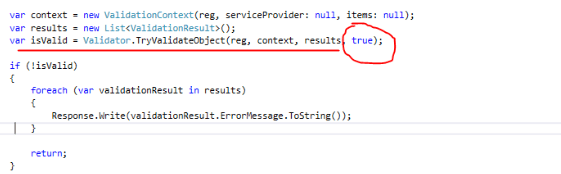
If you check the objectmodelvalidator source code you'll see it uses cached validators and model metadata to. While a particular field is being edited), it is often useful to validate every property in a class (e.g. // will contain the results of the validation bool isvalid = validator.tryvalidateobject(objecttovalidate, vc, results, true);
I Have Used Dot Net Core Web Api For This Demo.
There are attributes to mark a property as required, set a maximum length, and so on. When you click on implement interface 'ivalidatableobject' you will have the following interface. Create a new mvc4 or above application.
Tryvalidateobject (Object, Validationcontext, Icollection, Boolean) Determines Whether The Specified Object Is Valid Using The Validation Context, Validation Results Collection, And A Value That Specifies Whether To Validate All Properties.
If you check the objectmodelvalidator source code you'll see it uses cached validators and model metadata to. When submitting data in a form). A collection to hold each failed validation.
It Implements A Validatable Interface Automatically In Visual Studio.
By using the namespace system.componentmodel.dataannotations we can annotate our model's properties with validation attributes. This method tests each validation attribute in the validationattributes parameter against the value parameter. If the validationresults parameter is null, this method does not add.
The Negative Programming Version Also Exists.
Now, let’s add some validation attributes to the properties of our class. This functionality is provided thanks to validator.tryvalidateobject(): Dataannotation enables us to work with positive programming.
True If The Property Validates;
The.net framework provides a set of attributes that we can use to validate objects. While validating a single property is quite useful (e.g. If the validationresults parameter is not null, this method adds a validationresult object for each validation failure to the validation results collection.


Comments
Post a Comment